The Right Start
Buying a high-quality outdoor movie screen should never be complicated or frustrating. It can be pleasant from the start, and actually leave you feeling confident and appreciated for bringing movie entertainment to your community or replacing outdated equipment.
At first, the vast number of price points and product claims vying for attention can be intimidating. To save time and minimize confusion, focus on finding a reputable nationwide seller.
Three Part Harmony
Here are three characteristics of a movie equipment dealer that will improve the likelihood of a successful outdoor movie screen purchase:
- Seek companies where your use case is well known at every budget level. A customer base of thousands translates to more experience getting movie screens of all sizes up and running at a wide array of venue types. [1]
- Choose an audio/visual supplier employing a fulltime team of manufacturer-certified movie event technicians. Extensive hands-on experience setting up, operating, and servicing the equipment recommended for your venue(s) is invaluable. [2].
- Beware of resellers representing an extra-long menu of movie screens, but unable to explain design and construction nuances, precise performance benefits, and the logic behind suitability for specific uses. [3]
Free Site Consultation
Test the waters by requesting a free site consultation, because a great outdoor movie equipment supplier will not hesitate to offer detailed guidance with no strings attached. [4] Start by sharing venue-specific details:
- Open space dimensions, maximum viewing distance, and major variations in ground elevation [5]
- Estimated audience capacity and seating mode (chairs | blankets | drive-in | combination) [6]
- Significant sources of ambient light and direction of the sun at sunset [7]
- Distance to nearest accessible 110-volt electrical outlet on a circuit with up to 10 amps of spare capacity [8]
An Uncomplicated, Pleasant Experience
To summarize, a movie screen supplier with all the right stuff will offer:
- Exceptional knowledge of equipment relevant to your venue and events [2]
- Free site consultation(s) with no strings attached [4]
- Road-tested recommendations from screenings-as-a-service team [4]
- 24/7/365 phone and email support plus video or in-person training [9]
- Spare parts inventory includes replacement projection surfaces, elastic screen ties, blowers, ratchet straps, anchors, repair kits, equipment transport bags, and more [9]
- Direct resolution of a movie screen warranty claim if ever needed [10]
- An extensive library of customer resources including how-to tips, safety best practices, and more.
What Size Movie Screen Is Best For My Venue?
Professional movie screens are compared by the width of their projection surface. Beware of screen makers exaggerating screen size with corner-to-corner diagonal measurements. [11]
With so many factors at play, screen size selection can be streamlined by sharing venue specifications and event goals using the criteria outlined in the previous section. [12]
For a quick summary of audience capacity by screen size view this table. Otherwise, continue reading below to learn more about the screen-audience relationship.
Audience Perspective
Audience experience always needs to be the highest priority when specifying screen size. Even where venue capacity is a limiting factor, comfortable sightlines define the maximum viewing area for each screen width. [13]
Indoor movie theaters offer moviegoers an extraordinary viewing experience, and a high-quality outdoor projection surface can bring those cinematic standards to your venue. [14]
Horizontal Sightlines
The luminance table below illustrates the uniformity of a projection screen’s brightness. The flatter the curve, the more uniform screen luminance will be at viewing angles relative to a seat on the center aisle at 0°. Image brightness at key viewing angles is shown on the table’s second row, expressed as screen gain (a chalk white tile = 1). [15]

Visualizing the luminance curve above, audience members seated outside the 30° cone may notice a loss of brightness and, for planning purposes, the viewing area for a high-caliber outdoor movie screen should be limited to 45° off the center axis. [16]

Maximum Distance
Industry guidance for maximum seating distance from a movie screen is based on how much of the viewer’s horizontal field of vision the screen occupies, because sitting too far away offers a less immersive experience. [17]
A big-screen outdoor movie experience can be viewed comfortably at up to three times the projection screen width and, at furthest, from a distance projected images occupy approximately 20° of the audience’s field of view. [18]
- For comparison, the edges of a movie screen viewed from the last row of seats in a home or commercial indoor theater is limited to a 36° field of view in a THX certified theater or 30° based on Society of Motion Picture and Television Engineers standards. [19]
If curious, maximum viewing distance for an outdoor movie screen can be calculated using this formula:

Here is the recommend maximum viewing distance for six popular outdoor movie screen sizes:

Keep in mind: A bigger screen is viewable at greater distances, but projector brightness requirements increase in proportion to screen surface area.
Vertical Sightlines
On average, a seated person’s eye is 48 inches above the floor and a relaxed person naturally looks down about 15°, and relative to this sightline a comfortable vertical viewing zone is ±15° from the center of the screen to the top picture line. This recommendation addresses how far viewers need to tilt their head from their natural line of sight to see the screen’s center or top edge. [20]
An elevated bottom picture line (BPL) maximizes comfortable viewing distance by improving vertical sightlines, especially for people seated on the ground. [21]
Front row seating should ideally be no more than 25° from the audience’s natural line of sight to avoid discomfort or neck strain. [22]
Seating Arrangement
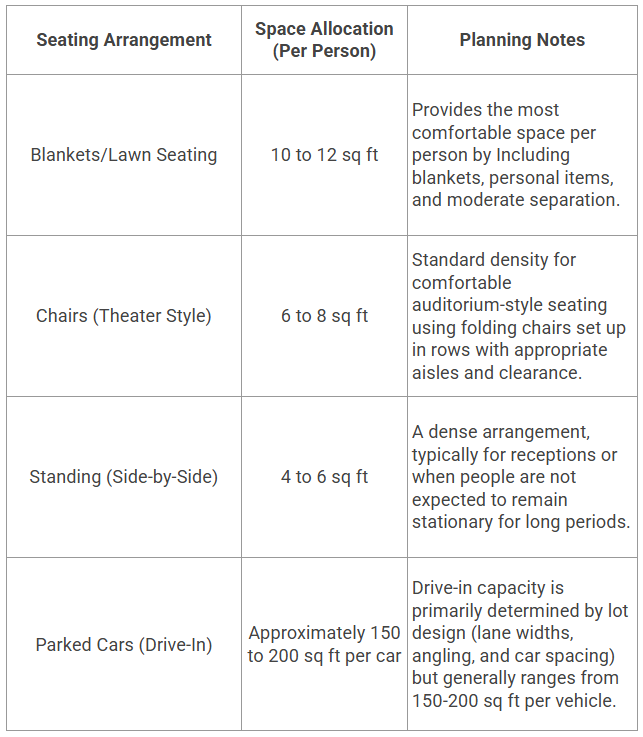
Spectator capacity of an outdoor movie screen also depends on seating arrangement. Emphasizing audience comfort, experienced outdoor event planners commonly use the following seating-allocation guidelines: [23]
All Factors Considered
Work with a trusted audio/visual professional to account for bottom picture line (ground-to-screen clearance), projection surface gain, projector brightness, hillside seating, and other sightline factors. [24]
The table below estimates audience capacity for six popular outside movie screen sizes based on typical space allocation, sightlines, and screen performance.
| Screen Width | Bottom Picture Line | Max Viewing Distance (ft) | Blankets/Lawn Seating (People) | Theater Style Chairs (People) | Drive-In (Parked Cars) |
|---|---|---|---|---|---|
| 12 ft | 5′ 0″ | 35 | 105 | 165 | |
| 16 ft | 5′ 11″ | 50 | 185 | 295 | |
| 20 ft | 5′ 11″ | 60 | 290 | 455 | 25 |
| 24 ft | 6′ 6″ | 70 | 420 | 660 | 35 |
| 30 ft | 6′ 6″ | 90 | 655 | 1030 | 55 |
| 40 ft | 6′ 6″ | 120 | 1165 | 1830 | 100 |
Portable Movie Screens: Inflatable, Fixed, or Folding Frame?
Inflatable Movie Screen Frames
Inflatable movie screen frames are the industry standard for audiences of 250 people or more, including models produced to entertain up to 10,000 people. Projection surfaces 16’ to 40’ wide are the most popular and uncomplicated to install. [25]
- Best engineered designs are held flat, stable, and ripple free in wind up to 24 mph
- One person can unfold, anchor, and inflate a 16-foot screen in 30 minutes
- Two people can setup a 30 or 40-foot screen in less than an hour [26]
Inflatable movie screens can be deflated and quickly laid flat when weather threatens public safety. Larger screen sizes with fulltime blowers provide great value to parks and recreation facilities. Venues with smaller audiences or sound-sensitive settings gravitate to run-silent models. Both designs are highly portable. [27]
- Sealed-air frames require fabrics and seams that are airtight, a labor intensive process. Having a screen that does not need a blower means quiet and silent operation and lower needs for electrical power. The downside is longer inflate and deflate times. Also, a small leak can cause the screen not to stay inflated. [28]
- Constant pressure inflatable screens with blowers set up more quickly and, if slightly damaged, remain usable. A factor to consider is the constant electrical draw [28]
Fixed Frame
Fixed frame outdoor movie screens are appropriate for permanent installations like drive-in theaters, or temporary events where lighting and drapes will share a rigid movie screen truss. [29]
Frame sections, support rods, snap buttons, and related components can be complex to assemble and typically take triple the setup time and more personnel than the same size inflatable screen. [30]
Fast-Fold Screens
Fast-fold movie screens are popular for indoors events and tradeshows. However, product manuals warn they are unsuitable for outdoor use due to wind and rain safety concerns. [31]
Fulltime supervision is essential even if the screen is anchored with sandbags, ground stakes, rigging cords, and support rings. Even in a gentle breeze, the force of air is magnified exponentially as screen size increases. [32]
Corners Not To Cut On Movie Screen Construction
Product performance and endurance varies broadly from one outdoor movie screen to the next. Knowledge is power, and your confidence in making an informed selection will improve after reading the sections below. [33]
RF-Welded
When you think of welding, do flaming torches bonding metal panels come to mind? Think instead of welding vinyl fabric with high-frequency radio waves, because that is how the best-performing inflatable movie screens are constructed. [34]
- Essentially, a focused high-frequency electromagnetic field fuses overlapping layers of movie screen fabric, starting inside the fabric and ending with the exterior surfaces.
- RF welds take longer and require more skill than hot air bonding, sewing, or gluing. The strongest inflatable movie screens are RF welded along every seam and at every d-ring anchor point, air inlet, and deflation port. [35]
When vinyl fabric customized to withstand extreme directional tear is welding by high-frequency radio waves, the movie screen frame is so strong it can withstand much higher inflation pressure (~30 mbar), making it rock hard like a tire and unable to bend, flex or move in the wind. [36]
An RF-welded frame with a projection surface held taut by a flexible bungee tensioning system dissipates wind energy better than any other inflatable movie screen system. [37]
Hot Air Bonded
Another method for connecting inflatable movie screen parts uses hot air. This process melts the PVC material together from outside to inside. [38]
It is faster (therefore cheaper) to melt PVC with hot air versus RF-welding from the inside out. The major downside is that melting outside surfaces before the fabric interior can hide defects from quality-control inspection. Consistency suffers, and real-world experience has shown hot air welded seams are significantly more prone to fail than RF welds. [39]
Sewn Seams
Inflatable movie screen parts can be also sewn together like clothing. No matter how dense the stitching, strong the thread, or thick the reinforced fabric: sewn seams and screen parts stretch, break, loosen and leak air faster than any other construction method. [40]
Seams sewn with heavy thread, reinforced panels and d-rings can be acceptable for light-duty use such as backyard events — but rely on RF-welding or hot air bonded construction for commercial/rental use. [41]
Side by Side
Broken seams and torn anchor rings are the heartbreak of owning an inferior movie screen. Ask about construction methods, which are essentially invisible in photographs, to quickly sort out which manufacturers produce the most reliable movie screen frames. [42]
Maximum wind resistance is a related claim prone to exaggeration. Even with similar anchoring methods, safe operation is a function of frame strength and rigidity. The most well-constructed inflatable movie screen in the industry says safe operation is limited to wind no greater than 24 mph. Treat higher wind speed claims skeptically. [43]
Projection Surfaces Audience Really Notice
Screen Surface Tensioning
A perfectly flat screen surface is essential for a large image. To achieve an attractive appearance use elastic screen ties to tension the outdoor projection surface flat, tight and ripple free. Elastic ties attach to the screen material at evenly spaced points around the frame, and because the cord is elastic, it provides consistent robust tension that pulls the material taut to stretch out wrinkles and waves that distort a projected image. [44]
Velcro (hook-and-loop) fasteners are found on simpler and lower-cost screen solutions. While the screen can be pulled tight during setup, the material is not under dynamic tension, making it less effective at removing creases or preventing new ripples and sags when the material is subject to gravity over time. Loosely supported materials are more prone to wrinkles and sagging. The adhesive on Velcro strips may also degrade over time when exposed to outdoor elements like moisture and UV rays. Sewn-in screen surfaces suffer similar shortcomings. [44]
Above all else: avoid zippers, a major point of failure cautioned by field observation. Trapped dirt, grass, insects, and small stones lead to zipper jams. One broken zipper tooth can render an entire screen inoperable.
Seamless And Washable
High-quality projection surfaces are made from smooth, seamless materials such as PVC vinyl or other projection-grade fabrics that reflect light evenly. [45]
Highly durable vinyl and coated fabrics tend to handle moisture, dirt, ultra-violet degradation, and other elements of outdoor exposure better than simple cloth or uncoated fabrics. [45]
Brightness, Gain, and Color Accuracy
Projection surface selection makes a huge difference in picture quality. Low end materials dim or distort light coming from the projector, so insist on Black Backing or integrated Ambient Light Rejection (ALR) technology to prevent light from bleeding through or washing out the image. Both features boost perceived contrast and color saturation, especially where ambient light is unavoidable. [46]
Screen gain is a scale indicating how bright a projected image is . A 1.0 gain projection surface, also called unity gain, reflects light equal to the reflection from a neutral white board, and the light spreads evenly across a wide viewing area. [47]
- Unity gain (≈ 1.0) or low-gain screens reflect light evenly and diffusely relative to a standardized white reference surface. Professional-grade front projection outdoor screens aim for neutral gain to balance brightness, contrast, and wide audience viewing angles. Screen surfaces with 0.96 gain tradeoff a slight amount of brightness for enhanced contrast, improved color saturation, and deeper blacks. [33] [13]
- High-gain screens, for example 1.5 gain, concentrate reflected light into a narrower viewing cone. This can be helpful for offsetting ambient light or using a lower-lumen projector. However, audience members seated near the center of a high gain screen may see a bright spot (“hotspotting”) and people positioned more than 25 degrees off the center axis see a dimmer image. [48]
Elevated Ground Clearance
Raising an outdoor movie screen projection surface far above the ground dramatically improves audience lines of sight and maximizes viewing distance. By elevating the screen, the viewing experience is more comfortable and immersive for viewers spread across an uneven field or on rising ground. Seeing over obstructions like the heads of people sitting in the first few rows or low-lying landscape features, ensuring those in the back can see the entire image. It is a design feature of the best inflatable outdoor movie screens. [49]
Elevating the fabric surface also protects it from ground moisture, dew, puddles, and loose debris like grass clippings or dirt that can splash up and degrade the screen surface over time. [49]
Which Is Better: Front or Rear Projection?
Front Projection Pros and Cons
- Higher brightness: The reflective coating of front-projection materials bounces more light from the same projector back toward the audience. Screen surfaces with black backing block ambient light behind the screen from dimming the projected image. [50]
- Simpler setup: Easier alignment with projector, screen, and audience all in one direction. Fewer space constraints behind the screen — ideal for small or obstructed sites. [51]
- More projector options: Front projection is compatible with nearly all projector lens types because manufacturers design and publish throw-ratio calculations assuming a standard front-projection geometry. [52]
- Projector visible to the audience: Viewers may walk in front of the beam. Requires a protected light path to avoid shadows and interruptions. [53]
- Cable trip hazard: Power and audio signal cables routed through audience areas must be managed and covered to reduce trip hazards during temporary public events. [54]
- Ambient light: Streetlamps, concession lighting, and other light sources striking the front surface reduce image contrast in front-projection systems. [50]
Rear Projection Pros and Cons
- Cleaner viewing area: In rear projection, the projector is positioned behind the screen and faces the audience through the screen material, eliminating visible light beams and equipment in front of viewers. [51]
- More flexible placement in tight venues where the audience must sit close to the screen or where front light paths are impractical (courtyards, amphitheaters, poolside). [51]
- Better crowd safety and control: With projectors and cabling placed behind the screen, crowd management is simplified by keeping equipment out of public walkways. [53]
- Higher perceived contrast: Because rear-projection screens transmit projected light, they can maintain higher contrast when unavoidable front ambient lighting is present. [50]
- Lower brightness: Rear-projection materials transmit 20–40% of projector light output, depending on screen gain, and require a projector with 30–50% higher output to match brightness comparable to front-projection screens. [50]
- More expensive materials: Specialized translucent or high-contrast rear-projection fabrics often cost more than typical front-projection materials and require precise tensioning to avoid hotspots. [55]
- Limited compatibility: Not all inflatable frames or rigid screen systems support rear projection, and some designs reduce usable image area due to frame supports. Confirm rear-projection or dual-surface compatibility before buying an outdoor projection screen. [55]
- Requires space behind the screen: A clear projection zone is needed behind the screen based on throw-ratio geometry, which may be impractical where walls, trees, or walkways are close behind the screen. [52]
Are front or rear-projection outdoor movie screens suitable for daytime events?
No. Daytime ambient light reduces projected image contrast to an unwatchable level. Plan for movies to start about 20 minutes after sundown. [56]
Are front or rear-projection outdoor movie screens suitable for daytime events?
FAQs | Frequently Asked Questions
How does movie screen size relate to audience capacity and seating options?
Two factors primarily affect audience size: screen width and seating mode (chairs, blankets, or cars). For example, a 20-foot screen fits approximately 450 people in chairs or 290 seated on blankets.
A big-screen outdoor movie experience can be enjoyed from a distance up to three times the width of the projection screen, however a tall “bottom picture line” (BPL) will substantially improve sightlines for viewers furthest away. Front row seating should be no closer than the screen is tall.
Also, place seats no more than 30° off the left/right vertical edge to avoid a noticeable loss of picture brightness (based on a 0.96 gain front projection surface).
In what ways do construction methods affect the performance and durability of an inflatable movie screen?
The stability and durability of an inflatable projection screen is primarily determined by how its frame materials are joined.
RF (Radio Frequency) welding is the superior construction method for professional use. Fusing vinyl layers with RF welding creates an airtight bond capable of withstanding high inflation pressures (~30 mbar) that ensure the frame remains rigid and stable in high wind.
In contrast, hot air bonding melts PVC screen fabric from the outside in — a faster and cheaper method which can hide internal defects and is more prone to failure than RF welds. Sewn seams are the least appropriate option for commercial applications because stitched seams stretch, loosen, and leak air over time.
What is the difference between sealed-air and constant-pressure inflatable movie screens?
Constant-pressure screens use a fulltime blower to keep the frame inflated and rigid. Because the blower perpetually replaces escaping air, the screen remains upright and usable even if the frame has minor leaks. Sealed-air screens function like a tire: inflate once then the valve is closed. They operate silently without a fan, and can be used at indoor or outdoor events. However, even with rigorous airtight construction a small leak can cause the frame to lose pressure and sag.
How does ambient light impact front versus rear projection movie screen surfaces?
Ambient light can be a challenge for outdoor cinema, although front and rear projection screens handle it differently.
High-quality front projection surfaces feature black backing to prevent light behind the screen from bleeding through and washing out the projected image.
Rear projection screens transmit light from behind, improving perceived contrast and reducing washout from light coming from the audience direction. The trade-off is efficiency: rear projection materials typically transmit just 20–40% of the projector’s light output, requiring a projector 30-50% brighter than a front-projection setup.
Which features of a movie projection surface have the greatest impact on image quality and viewer enjoyment?
Screen mounting methods have a profound impact on an audience’s cinematic experience. The superior choice for attaching a movie screen to its frame is a flexible bungee system that uses elastic screen ties to hold the screen flat, taut, and free from puckers that distort the projected image and allow fluttering in the slightest breeze.
Screens attached by Velcro (hook-and-loop) and sewn-in surfaces are less effective because they lack the dynamic tension that prevents sags and folds caused by gravity and how screen fabric relaxes over time.
In all cases, avoid zippers because they are susceptible to jamming and breaking due to dirt and debris.
Equally important, use manufacturer specs to identify true cinema fabric based on color accuracy, off-axis brightness, seamless construction, and ambient light mitigation features.